Few things in the history of automotive technology can have progressed quite as rapidly as the lithium-ion battery pack, variations of which power all EVs on the roads today.
When Tesla broke the mould in 2013 with the Model S, its battery comprised many thousands of individual ‘18650’ cylindrical cells. The name is derived from the dimensions of each one, 18mm in diameter and 65mm long, so not unlike a domestic battery in shape.
An individual 18650 cell generates only a few volts but connecting them together in series gives the hundreds of volts needed for an EV traction battery. Grouping them in parallel provides capacity and increases current. Choosing the 18650 format was a clever move because it was already an industry-standard battery, but there are other formats too.
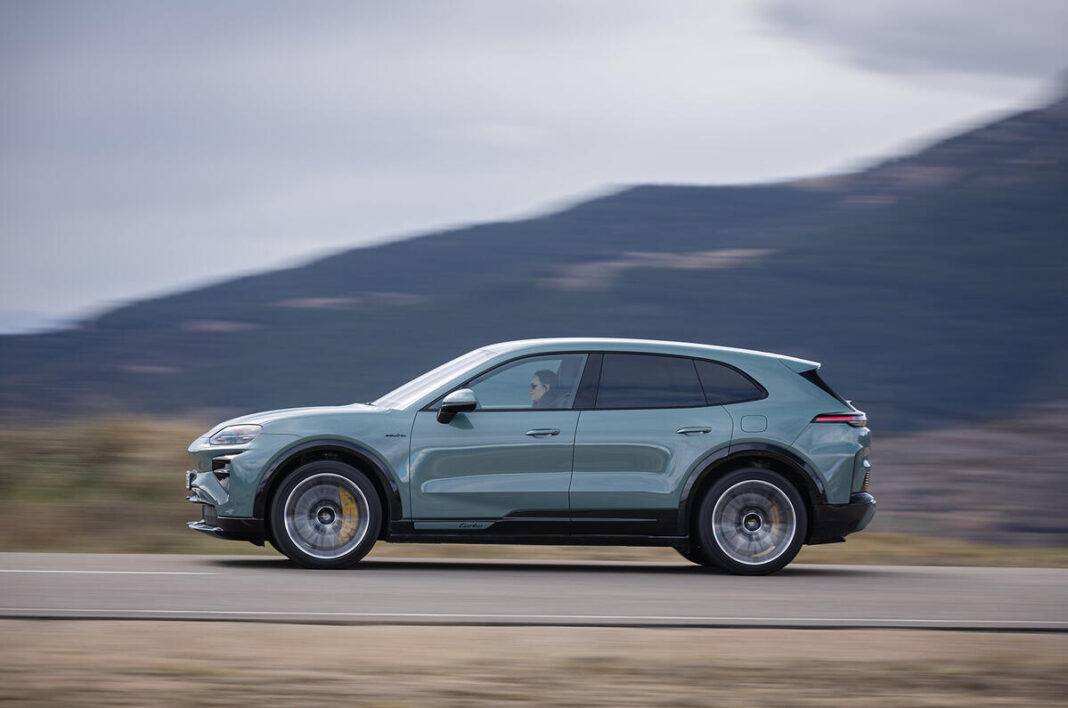
One such is pouch cells. The very first Nissan Leaf used pouch cells and, in that sense, the new Porsche Cayenne EV has something in common with it.
The Leaf was launched globally in 2010 and arrived in the UK two years later. It was capable of around 70-80 miles on a single charge of its 24kWh battery, which comprised 192 pouch cells, four in each of 48 modules.
The Cayenne battery is also made up of 192 larger pouch cells, 32 of them in each of six modules. But it’s a world away from the little Leaf battery when it comes to capacity: its 113kWh gives the high-performance SUV a range of over 370 miles.
How are these incredibly powerful batteries made? Porsche assembles the modules at its Smart Battery Shop at Horná Streda in Slovakia using cells made in Europe. Once the cells have been manufactured, they are shipped into the plant for installation into the modules. A supplier equips the finished modules with high-voltage cables and associated connectors and an external contractor assembles the six complete modules into the high-voltage battery pack.
Assembly of the modules takes place in immaculately clean conditions, with strict standards protecting the components from electrostatic discharge. The pouch cells are tested and prepped and then stacked on top of one another with highly accurate alignment of the connectors.
These stacks are inserted into cell carriers and the cell tabs (connectors) are positioned and joined by automated laser welding. A foam material is added to stabilise and protect the stacks and thermally conductive materials inserted between the cells to aid heat dissipation.
After electrical, function and dimensional tests, insulation measurements and a thorough visual inspection, the modules are shipped to the contractor for final battery assembly. Production data for each module is recorded and Porsche says it will be able to trace each one even after many years.
Finally, before assembly into the cars, batteries undergo performance testing in Porsche’s own analysis centre, where the focus is on longevity and charging capability.