

5 Fast, Powerful Mercedes That Aren't AMG-Branded
If you want to understand AMG, picture a company Mercedes-Benz bought specifically to turn its luxury cars into proper sports cars. In practice, that means more power, sharper throttle response and handling, a dose of carbon fiber for weight savings, and simply more of everything that makes a car thrilling to drive. A big part of that formula happens under the hood: the range-topping cars get hand-built engines, each one assembled by a single technician under AMG's "one man, one engine" philosophy. It's craftsmanship as much as engineering, and it's a huge part of what the AMG badge actually stands for.
Still, AMG doesn't have a monopoly on fast Mercedes cars — not even on its own turf. Since folding fully into Mercedes in 1999, AMG has stayed busy, but Mercedes has kept turning out quick and powerful machines that never got the AMG badge at all. Some of these cars buried AMG hardware under sensible limousine bodywork. Others were motorsport experiments, electric SUVs, or range-topping luxury flagships that simply didn't need the AMG treatment. The following are five cars that prove Mercedes-Benz knows how to go fast even when it isn't actively trying to sell you its AMG division.
Mercedes-Benz SLR McLaren
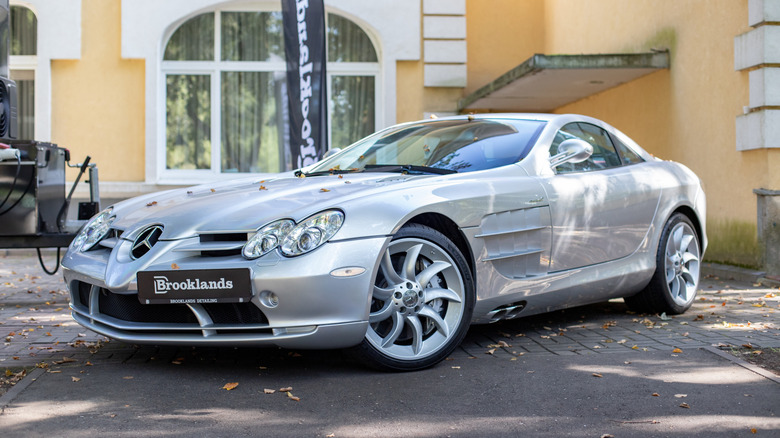
Jointly developed by McLaren and Mercedes, the Mercedes-Benz SLR McLaren did not get the AMG treatment, and you won't find any AMG badges on it. Granted, the engine it carries was developed and hand-built by AMG in Affalterbach, and it shows how some of the most powerful Mercedes cars actually hide AMG engines under the hood. So why no AMG badge? The SLR was conceived as a joint Mercedes–McLaren halo car and a modern nod to the 300SLR racer of the 1950s, built during the years Mercedes ran its Formula 1 program alongside McLaren. McLaren handled the carbon-fiber monocoque and final assembly in Woking, England, so the car carried the SLR and McLaren identity rather than the name of Mercedes' in-house performance division.
As stated, AMG's job was the hand-built engine, not the badge on the trunk. The supercharged 5.4-liter V8 in the SLR makes 617 horsepower and 575 lb-ft of torque. In the range-topping 722 Edition SLR, power is pushed to 641 horsepower and 605 lb-ft. All of this is mated to a five-speed automatic transmission and is sent to the rear wheels only. The consensus is that only 2,157 SLRs were built between 2003 and 2010, split across coupe, roadster, and the open-top Stirling Moss speedster. In terms of speed, there are not many AMGs that can go as fast as the SLR can. If you have the space, the SLR 722 will reach 60 mph from a standstill in just 3.6 seconds while topping out at 209 mph.
Mercedes-Maybach S 680
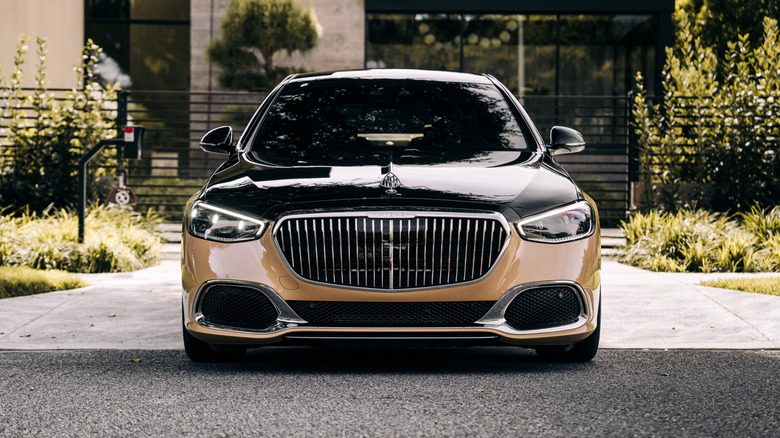
The most powerful combustion Mercedes you can buy today without an AMG badge runs an engine that used to wear one. The Mercedes-Maybach S 680's 6.0-liter twin-turbo V12 is the M279 – the same unit that powered the S65 AMG until Mercedes wound down its V12 performance cars. AMG stopped building V12-badged models, but the engine lived on — and the Maybach is now the only Mercedes you can buy with it.
In the S680, it makes 621 horsepower and 664 lb-ft of torque, enough to move a full-size luxury limousine from 0 to 60 mph in 4.3 seconds and on to an electronically limited 155 mph. In the 2021 W223, it also became the first V12-powered Mercedes road car to send its power to all four wheels through 4MATIC. However, there's a big catch to owning one. The V12 no longer meets Europe's emissions rules, so Mercedes pulled it from the continent entirely. If you want the twelve-cylinder S 680, you'll need to shop in the US, China, the Middle East, Japan, or South Korea — everywhere else, the Maybach S-Class tops out at the V8 S580. That scarcity, plus a V12 clearly on borrowed time, is what makes it one to watch. And although the S 680 is as powerful as the SLR we talked about before, their specific use-case scenarios are vastly different. The V12 in the S 680 is tuned for smoothness before anything else, and in many situations, people prefer being driven in them, not driving them.
Mercedes-Maybach EQS 680 SUV
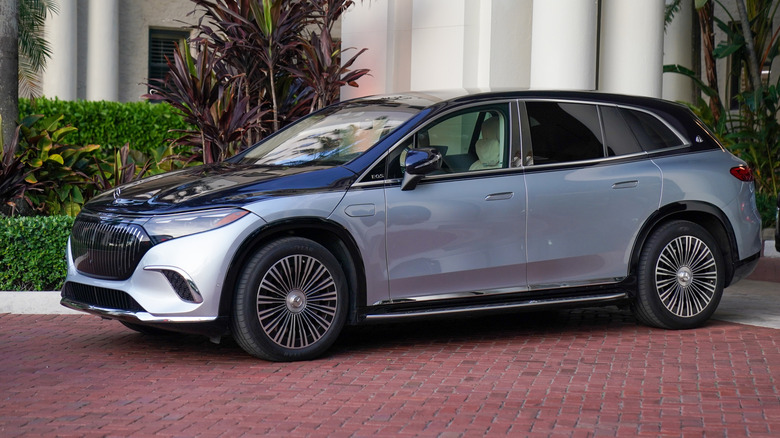
The Maybach EQS 680 SUV is the most powerful non-AMG Mercedes-Benz. However, its electric motors do come from an AMG. The twin-motor layout is the same one Mercedes fits to the AMG-infused EQS 53 sedan, which is how the Maybach version ends up with 649 horsepower and 700 lb-ft of torque — a big jump over the 536 hp the standard EQS 580 SUV musters. That's enough to launch this 6,779-pound ultra-luxury SUV from 0 to 60 mph in 4.1 seconds, though top speed is capped at 130 mph. The AMG EQS 53 starts at that same 649 hp but stretches to 751 with its optional Dynamic Plus boost — a party trick the Maybach does not come with.
Its rather sizable 118-kWh battery is good for right around 280 miles on the EPA cycle, and it'll DC fast-charge from 10 to 80 percent in roughly half an hour. It is worth mentioning that none of these have actually helped make the EQS SUV sell well. Mercedes discount on the Maybach EQS is so big to buy an entirely separate Mercedes.
2026 Mercedes-Benz G 580 with EQ Technology
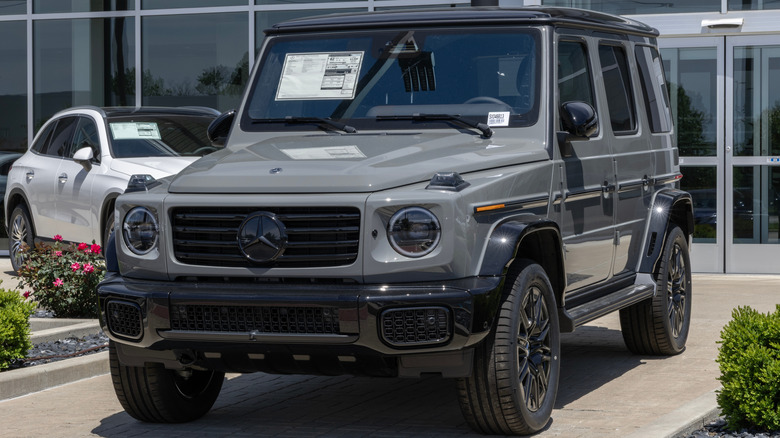
Every car we mentioned thus far has hidden AMG bits somewhere. For the SLR and the S680, it was the hand-built engine; for the EQS, it was the electric architecture. The electric G-Wagon breaks from that pattern. Mercedes-Benz credits the car's four-motor system to the Mercedes-Benz Group itself, specifically noting that the G580 with EQ tech is the first mass-produced Mercedes model with genuine individual-wheel drive. In other words, one motor drives each wheel, together putting out 579 horsepower and 859 lb-ft of torque. Interestingly enough, the G 580 actually out-torques the top-spec gas-powered AMG G 63, which manages 627 lb-ft. Still, straight-line speed favors the G 63, in large part because it is roughly 1,200 pounds lighter compared to the electric G.
Still, the G 580 can reach 60 mph from a standstill in about 4.1 seconds, according to Car and Driver, and top out at a limited 112 mph. This is a safe platform limit more than the actual top speed of the G-Class chassis, since even the G63 AMG's top speed is 137 mph. The G 580 also gets the party-trick "G-TURN" mode, which lets it rotate around its own axis on loose ground like a tank. It's genuinely unique in the Mercedes lineup — though a 2026 recall covering 3,734 early electric G-Wagens found their wheel bolts could fall off under the electric drivetrain's added torque. A 116-kWh battery sits low in the ladder frame for an EPA-estimated range of around 239 miles. Moreover, 200-kW fast charging gets it from 10 to 80 percent in roughly half an hour.
Maybach 57 S
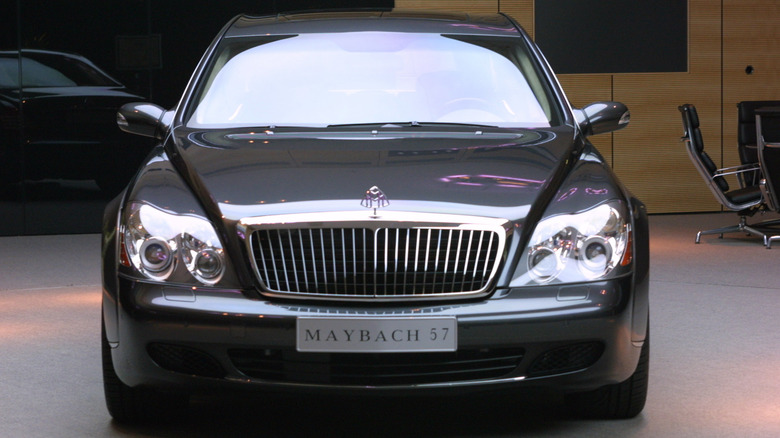
Maybach used to be sort of its own brand within the Mercedes umbrella when it launched the 57 S and the long-wheelbase 62 S in 2005. Both ran a 6.0-liter twin-turbo V12 lifted straight from the Mercedes S65 AMG, making 604 horsepower and 738 lb-ft of torque. This allowed the shorter 57 S to reach 60 mph in under five seconds and reach a claimed top speed of 172 mph. This was not the end of it, though. Mercedes gave the 57 S and 62 S a mid-cycle facelift at the 2010 Beijing Motor Show, and quietly bumped the same AMG-built V12 to 630 horsepower, while torque remained unchanged at 738 lb-ft. That's not just more power than the originals — it's more than the 621-hp Maybach S 680 that carries the Maybach name today.
In its facelifted guise, the 2010 630-horsepower 57 S could reportedly reach 60 mph in as little as 4.6 seconds, with an unrestricted top speed estimated at over 190 mph. This underlines just how special the Maybach lineup was at launch. In 2003, the standard Maybach 57 started at $308,000. By the time the 604-hp S variant arrived for 2006, its base price had climbed past $367,000. Thankfully, depreciation hasn't been kind to either of these, and the cheapest 57 S examples have sold for as little as $44,000.