|
In Miami, the Silverstone team had introduced some innovations in gear management, but they didn't deliver the results the engineers had expected. The transmission had some teething problems: tests were conducted on the Honda dyno to improve the communication between the power unit and gearbox. Aston Martin is the biggest disappointment of this season's start, certainly more so than Cadillac, the eleventh team making its debut in the F1 world championship. The AMR26 was among the most anticipated cars, since the "green" was the first car designed by Adrian Newey. The English genius found himself operating in a completely new world, with a team equipped with perhaps the most modern facilities at the new Silverstone Campus, but the feeling is that the team hasn't yet acquired the top-tier mentality it aspires to. Hence the gap between a factory that isn't yet fully operational compared to its potential and an organization that, perhaps, has grown too quickly for a change in mentality that isn't easily achieved simply by changing a few people. When Adrian was persuaded by Lawrence Stroll to become a partner with a small stake in the company, he didn't expect to find an environment still in full turmoil, with more faces leaving than those selected to join. And the revolutionary changes weren't limited to the convoluted 2026 regulation with the introduction of agile single-seaters powered by power units capable of producing power halfway between an electric motor and an internal combustion engine. For Aston Martin, the difficulties multiplied: Stroll Sr. wanted to secure a factory supply, stepping away from being a Mercedes customer team. But the Silverstone team could rely on the "Star" not only for the availability of the PU, but also the gearbox and rear suspension. Essentially, the "green" team had been able to rely on the W16's rear end for years, finding itself part of the… ready-made mush. Focusing on an exclusive partnership with Honda for the supply of the power unit, the British team had to broaden its expertise by considering the design of the entire rear end. The partnership with the Japanese manufacturer was born out of the utmost trust, relying on the fact that Sakura had enjoyed a winning run with Red Bull and Max Verstappen that yielded four world titles. Honda, however, after announcing its withdrawal from F1 at the end of 2020, had assigned its best technicians to other projects, and when it decided to return, it entrusted the complex task to engineers who were part of the second tier. And the mistake of Andy Cowell, the highly respected former Mercedes engine designer, who in the meantime had become CEO and team principal of Aston Martin, was not to establish a close collaborative relationship with the Japanese. When it came time to join forces on the AMR26, all the problems emerged: the engine seemed far behind not only in performance, but also in reliability. Harmful vibrations, which also affected the chassis, put the batteries under strain. The first emergency was to turn off the toxic frequencies, but the power unit is unquestionably the worst in the circus and will benefit from a very "special" ADUO (in terms of number of updates and expanded budget cap) compared to the other struggling manufacturers. But Adrian Newey has put his… weight behind it, designing a car with very extreme solutions both in terms of aerodynamics and mechanical choices: the suspension, both front and rear, is all multi-link without traditional wishbones. In all of this, building the transmission in-house for the first time was an additional challenge because the team lacked a specific culture. And the newly formed department is struggling: teething problems have affected performance, with gear changes often slow or too abrupt. In Miami, Aston Martin was criticized for not having brought any upgrade packages: Newey decided to focus on a very different car that will be seen shortly before the summer break, if not at Zandvoort. In the meantime, the Silverstone technicians have been working on the electronic gear management, with the aim of reducing gear shift times, but judging by the drivers' complaints, the step forward has not been seen, making the AMR26 very unstable under braking and with complicated gear synchronization that is always difficult under acceleration. Meanwhile, the engine and gearbox have been running on Honda's dyno in Japan, and the fine-tuning of the electronics at Sakura should allow for a quantum leap in Montreal, a track that emphasizes stop-and-go capabilities and where traction plays a role in performance. Will this be the first (small) turnaround? submitted by /u/IamMrEric |
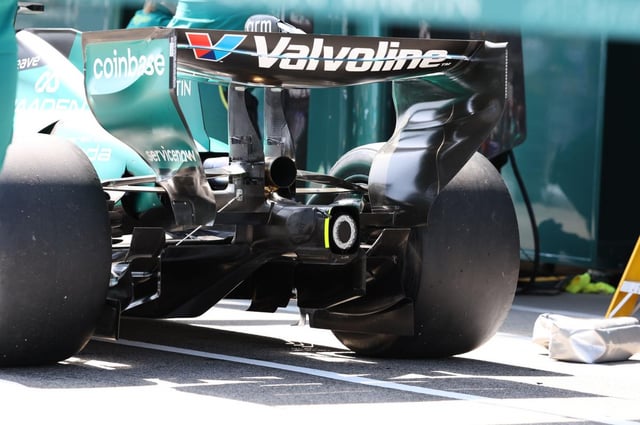
F1 | Aston Martin: Expect the AMR26’s first… step change in Canada
Popular Categories


Previous article
Next article