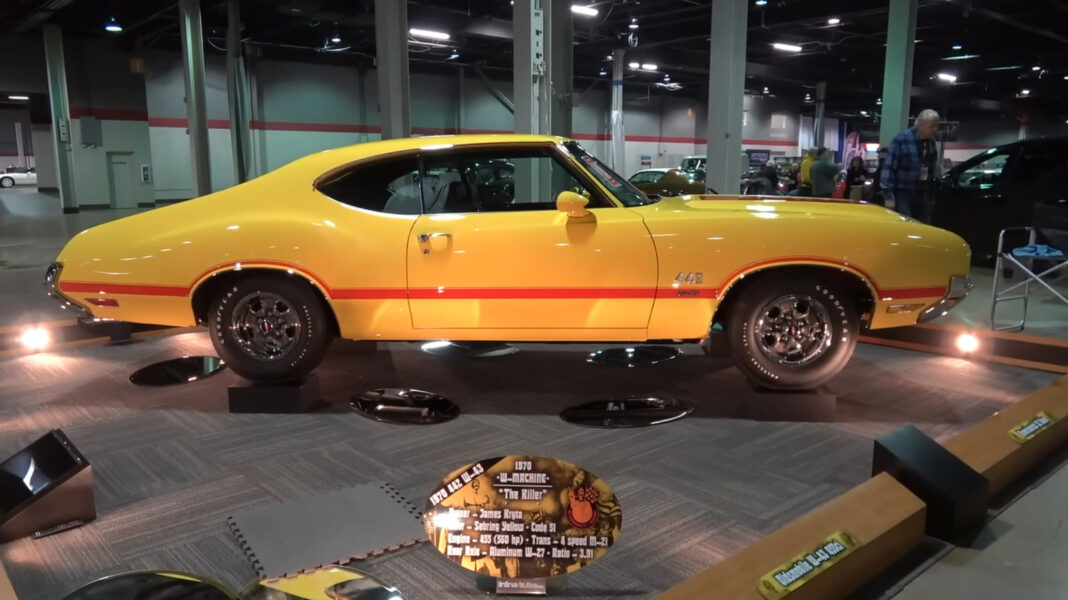
Despite Oldsmobile’s eventual reputation for living down to its name, you might have wished its final products were, in fact, more like your father’s Oldsmobile. At least, if your dad grew up in the muscle car era. Not only did the brand produce what’s actually considered America’s very first muscle car, but it also came close to producing one of the most powerful.
Oldsmobile got as far as creating an engine that would provide that motivation: the W-43, a massive 455-cubic-inch V8 with four valves per cylinder and dual overhead camshafts. Built on the foundation of the Rocket 455 V8 and offered in cars like the Oldsmobile 442, the W-43 raised the horsepower bar considerably. While the Rocket was good for 390 horses in the Hurst/Olds 442 special edition, Hot Rod magazine reported that the W-43, even early in its development, could unleash 440 horsepower at just 4,600 rpm. A modern dyno test, run on an original W-43 — one of two Oldsmobile is believed to have built — turned things up even further. Found and revived under the direction of James Kryta, the motor cooked up 560 horsepower at 6,000 rpm backed by 540 pound-feet of torque at only 3,600 rpm. Kryta went on to mount that motor in a classic 442, too.
For some context, the Chevy Chevelle SS 454 debuted in 1970 with 450 horses. At the time, that was the highest factory horsepower rating ever for a production motor. The W-43, though, never made it into production. It was killed off by the looming switch to unleaded gas in 1973, as well as a new focus on efficiency and emissions rooted in the oil crises of the same decade.
What made the W-43 so powerful?
You can’t pull all of those ponies out of thin air, of course. The W-43 had more than its share of performance enhancements over its predecessor, the production W-30 455 V8. Right off the bat, the W-43 had its own block casting and cylinder heads. It needed to accommodate a raised camshaft for its overhead cams, and that led to the bearing housings for that shaft being nestled into an open valley between the cylinder banks. Meanwhile, the cylinder heads themselves were configured with centered spark plugs, and the crankshaft itself was borrowed from the W-30 — but it was secured by four-bolt main caps instead of the regular 455’s two-bolt caps.
As mentioned, the W-43 further featured 32 valves, doubling the number from the W-30. With some help from its wide intake ports, this change greatly improved airflow. (You might think “the more, the merrier” when it comes to valves, but Maserati proved otherwise when it tried to build an engine with six valves per cylinder.) Many of the other valvetrain components — such as the lifters, push rods, and rocker arms — were unique to the W-43, too.
You should also know that the influence of the W-43 carried on after Oldsmobile dropped the original project. Everything Olds engineers learned from experimenting with four valves per cylinder on the W-43 went into the creation of the four-cylinder Olds Quad-Four engine — the first motor from a domestic automaker with that setup.