Anika Wells named as part of Time 100 ‘most influential rising stars’ list
Josh Butler
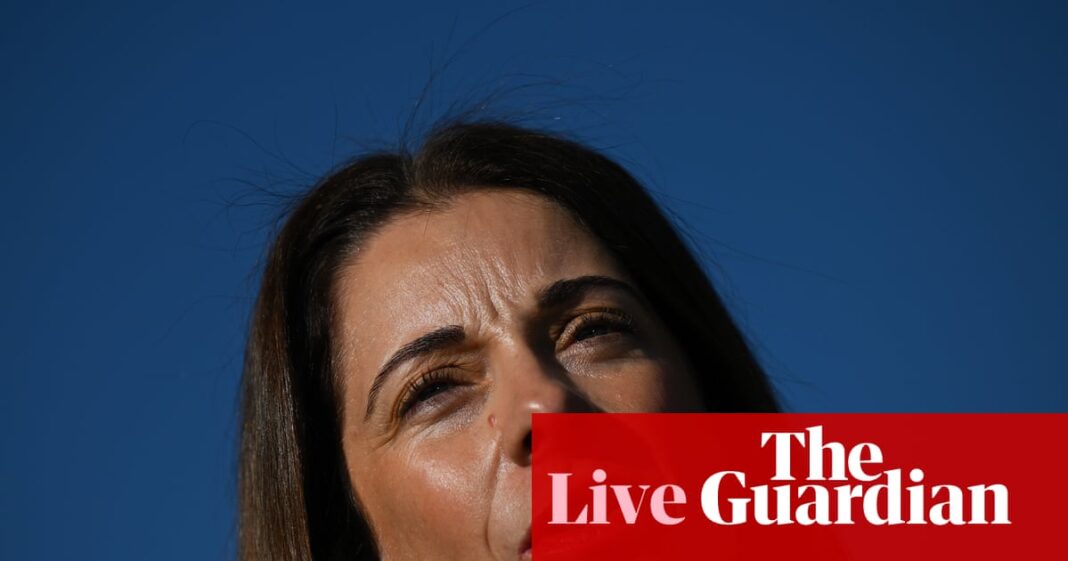
The federal communications minister, Anika Wells, has been named as one of Time magazine’s “world’s most influential rising stars”, as part of its annual Time 100 list.
Wells, who has overseen the under-16s social media ban and is now working on a world-leading digital duty of care framework, was included on what Time calls its list of “leaders who are shaping the future”.
Also on the list: musicians Sombr and PinkPantheress, soccer player Folarin Balogun, US senator Andy Kim, the Dutch prime minister, Rob Jetten, and Donald Trump’s political adviser James Blair.
Wells was published in the list alongside a testimonial written by the former Labor PM Julia Gillard:
As the world grapples with the extraordinary power of social media and the increasingly pervasive role it plays, Anika Wells has emerged as one of the most significant voices in a growing global movement to reframe the relationship between technology and the well-being of our children.
Even in the face of intense opposition from some of the world’s largest tech companies, she remains steadfast … Future generations will look back on her landmark changes as courageous and trail-blazing.
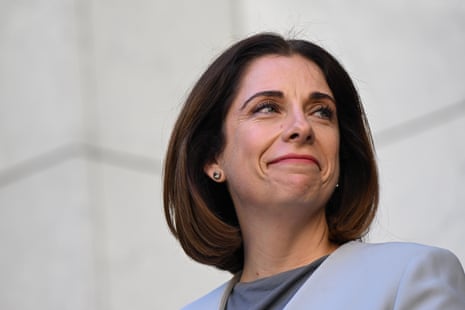
Australian musician Troye Sivan was also included on the “influential rising stars” list, with a testimonial written by Kylie Minogue. She wrote:
Troye Sivan is a perfect 2020s pop star… Troye doesn’t just make pop music to love. He makes pop music to believe in.
Key events

Luca Ittimani
RBA denies staff a pay rise that keeps up with inflation
The Reserve Bank rejected its own staff’s requests for a real pay rise and backpay on lost wages just hours after it hiked interest rates on Tuesday.
While the RBA has repeatedly warned that inflation-matched wage growth risks pushing up consumer prices, its employees argue the bank’s own forecasts show their pay will slip behind the cost of living.
As staff left the office on Tuesday evening, Bullock emailed them asking them to vote for a pay offer nearly identical to one already rejected by 54% of staff in July.
Read more here:

Adeshola Ore
Victoria’s South Sudanese Australian working group calls for youth justice reforms
A group of South Sudanese Australian leaders in Victoria have called for mandatory anti-racism training for all school staff and ramped up efforts to target organised crime groups preying on young people to reduce the over-representation of the community’s children in the justice system.
The recommendations are contained within a report by the state’s South Sudanese Australian Youth Justice Expert Working Group report, delivered to the state government earlier this year and released publicly on Thursday.
The report contains 59 recommendations designed to reduce the over-representation of South Sudanese Australians in the state’s youth justice system.
The government has established a committee to oversee the implementation of the recommendations. But its response has not outlined which specific recommendations it has accepted.
The state government said it had already commenced work on some of the recommendations while some required “policy, funding, cultural and operational implications that require careful consideration and planning.”
Victoria’s youth justice minister, Ros Spence, said the government was working with the South-Sudanese community to stop crime before it starts and ensure “young people have the support to stay on the right path”:
Our response is the result of listening to South Sudanese young people, families, and community leaders. We thank them for their leadership and for putting forward practical solutions.
NSW seeks to join Queensland in defence of ban on ‘from the river to the sea’

Penry Buckley
The NSW government has sought leave to join the Queensland government in a high court case brought by pro-Palestine protesters against laws banning the contested phrases “from the river to the sea” and “globalise the intifada”.
A spokesperson for the NSW attorney-general, Michael Daley, confirmed that the government had sought to be a party to the case alongside the Queensland government, but declined to comment further. High court listings show the attorney general filed leave to intervene in the case last week.
In a statement, Remah Naji, a spokesperson for Justice for Palestine Magan-djin, who brought the challenge, said:
What the NSW government fails to understand is that by intervening, they’re playing directly into our hands. This intervention was expected. We will use it to transform this from a Queensland case into a national struggle, one in which all people of conscience have a stake.
The NSW premier, Chris Minns, announced plans to prohibit the phrase “globalise the intifada” after the Bondi attack, but not “from the river to sea”, sending the issue to a parliamentary committee. But after Queensland legislated a ban on both phrases, leading to dozens of arrests, Minns walked back his stance, saying he was looking to the result of a challenge by protesters before introducing laws in NSW.
Job vacancies fell again in August
The Australian Bureau of Statistics released new figures this morning showing job vacancies fell again in August 2026.
Vacancies sat at 325,000, according to quarterly figures, Sean Crick, the ABS head of labour statistics, said:
The decline in job vacancies was driven by the private sector, notably in business goods and services. This was offset somewhat by rises in customer facing roles including in Retail trade.
Over the year, job vacancies declined by 1.3%. The wholesale trade industry had the largest quarterly drop, of 18%, followed by professional, scientific and technical services, down 17.3%.
The largest percentage rises in job vacancies were in retail trade, up 24.5%, followed by financial and insurance services, up by 14.1%.
Israel issues ‘heightened alerts’ after flydubai attack
Tess Ikonomou
Israel’s ambassador to Australia, Hillel Newman, says his nation will tighten security following the alleged stabbing attack on a flight en route to Tel Aviv.
The top diplomat said it will be alleged the Omani co-pilot involved in the attack had attempted to crash the plane.
This is a heightened alert period, and of course … Israel will take the precautions.
Prime minister Netanyahu gave a briefing last night, in which he said that there is heightened security alerts.

Patrick Commins
RBA warns of risk that AI boom goes bust
The Reserve Bank has warned that a sudden loss of faith in the artificial intelligence boom could trigger “disorderly asset price corrections” and that “Australia is unlikely to be immune” from the impact.
The RBA’s latest financial stability review said “threats to global financial stability continue to mount”.
Alongside the huge sums being invested in AI, two ongoing conflicts – in the Middle East and Ukraine – alongside “intensifying strategic competition among major powers” underscored these threats, the RBA said.
High valuations in global corporate debt and share markets meant they were vulnerable to a “disorderly” correction.
“One possible trigger could be a shift in sentiment towards the AI investment boom, which is increasingly fuelled by expectations of sustained rapid earnings growth and a debt-financing cycle that is becoming more opaque and circular,” the report said.
The RBA also warned of the rising risk of cyber-attacks, potentially facilitated by AI, and a sudden sell-off in global bond markets.
These external factors are the most prominent threats to financial stability in Australia.
Penry Buckley
Sydney’s metro extension meets key safety approvals – but some doors won’t open
The NSW transport minister, John Graham, says the highly anticipated southwest extension of the Sydney Metro has received key safety approvals, but after discussions with the safety regulator, six doors on the line will not be in use when it opens later this year.
Providing an update at a press conference this morning, Graham said:
As part of the initial safety case when first passengers jump on this train, we’ve agreed with [the Office of the National Rail Safety Regulator] that six of those doors will stay closed, so that there’s no even minor safety issues as this runs …
They’ll be clearly signed so passengers know just one of the safety measures in place for this complex build that we’re undertaking on what is a 130-year-old railway.
They include three sets of doors at Dulwich Hill, and one each at Marrickville, Canterbury and Campsie. Graham said it was an “ongoing discussion” whether these doors will eventually be in use.
The issue relates to mechanical “gap-fillers” that have been added to fill the space between the train and curved platforms on the historic line, with the issue affecting doors where those gaps are widest. There are 360 doors across the 10 stations that are part of the extension, with 18 on each platform at Dulwich Hill.
This morning, Graham said “we’re confident we’ll be able to operate this railway safely very shortly”.
No sign of negative equity crisis despite property slump
Patrick Commins
The Reserve Bank estimates that fewer than one in 100 borrowers owe more on their home than its worth, despite this year’s broadening price falls.
The RBA in its latest financial stability review said Australia’s household sector was largely coping well with rising interest rates and a recent decline in real incomes. The biannual report said:
While some households continue to experience hardship, the estimated share of mortgagors in severe financial stress or in arrears has, so far, remained low, supported by the strong labour market and mortgagors’ savings and equity buffers.
The RBA’s estimate that fewer than 1% of borrowers were in “negative equity” came with the caveat: recent buyers who took out loans worth close to the value of the property were more likely to now be in the position where the mortgage was higher than their home’s market value.
This included those who took advantage of the government’s 5% home guarantee scheme, the RBA said, although evidence suggested that the share of these borrowers falling behind on their payments remained “contained”.
The RBA estimated that even a 20% property price crash would only push about 5% of mortgages into negative equity – a testament to the fact most homeowners have enjoyed significant value gains over the years. The report said:
Negative equity is insufficient to trigger default if borrowers remain able to service their loans, which remains the case for the vast majority of these households.
Anika Wells named as part of Time 100 ‘most influential rising stars’ list

Josh Butler
The federal communications minister, Anika Wells, has been named as one of Time magazine’s “world’s most influential rising stars”, as part of its annual Time 100 list.
Wells, who has overseen the under-16s social media ban and is now working on a world-leading digital duty of care framework, was included on what Time calls its list of “leaders who are shaping the future”.
Also on the list: musicians Sombr and PinkPantheress, soccer player Folarin Balogun, US senator Andy Kim, the Dutch prime minister, Rob Jetten, and Donald Trump’s political adviser James Blair.
Wells was published in the list alongside a testimonial written by the former Labor PM Julia Gillard:
As the world grapples with the extraordinary power of social media and the increasingly pervasive role it plays, Anika Wells has emerged as one of the most significant voices in a growing global movement to reframe the relationship between technology and the well-being of our children.
Even in the face of intense opposition from some of the world’s largest tech companies, she remains steadfast … Future generations will look back on her landmark changes as courageous and trail-blazing.
Australian musician Troye Sivan was also included on the “influential rising stars” list, with a testimonial written by Kylie Minogue. She wrote:
Troye Sivan is a perfect 2020s pop star… Troye doesn’t just make pop music to love. He makes pop music to believe in.
Penry Buckley
Minns says ‘incumbent upon all of us’ to reduce public spending amid high inflation
The NSW premier, Chris Minns, has again defended the state’s record on inflation, as he seeks to distance himself from the federal government ahead of the March 2027 election.
Following calls by the former RBA governor, Philip Lowe, for federal and state governments to reduce public spending and run large budget surpluses amid high inflation and interest rates, Minns yesterday defended NSW’s record, saying “we’ve been careful with public money”.
Asked about Lowe’s comments again on 2GB today, and whether the prime minister and federal treasurer needed to be “called out”, Minns said:
Well, I think it’s incumbent upon all of us … me included, and all of the premiers as well. I mean, the Reserve Bank’s been really clear. Public demand, government spending in the economy is pushing or putting pressure on inflation, as is other things like the war in the Middle East and Donald Trump’s decision to spark a war in Iran.
But the truth of the matter is, there’s not much we can do about that geopolitical conflict unless Donald Trump’s listening to this program, and even if he is, I don’t think it’d make a difference. So we have to be look at spending in NSW, whatever we can do, and we’ve tried to do that.
Minns went on to say that NSW was the “only state with a AAA credit rating from [rating agency] Fitch”.
We think that protecting public money, particularly as we get close to an election campaign where political parties are up for spending everything to try and get re-elected, we just can’t throw the barn out because the public are about to go to the polls.