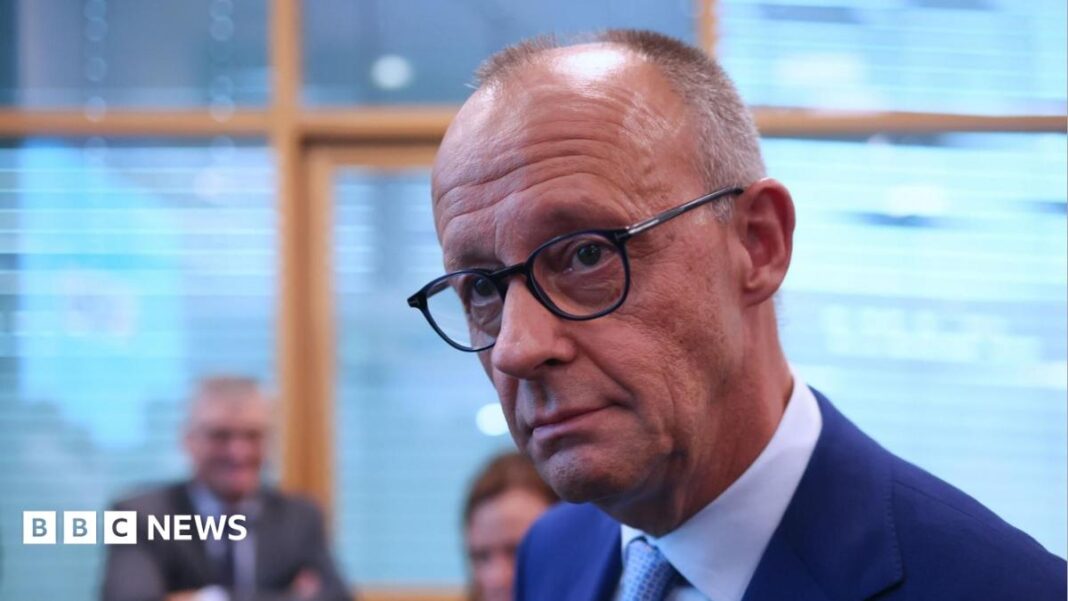
Embattled German Chancellor Friedrich Merz has vowed to stay on despite exit polls in two local elections suggesting damaging defeats for his centre-right Christian Democratic Union (CDU) party.
In the north-eastern state of Mecklenburg-Vorpommern, the party was initially projected to scrape through with its worst ever election result. But a few hours later, it dipped below the 5% threshold needed to stay in parliament. Merz called it “a disaster” for his party.
Meanwhile the far-right AfD was on track to win the most votes in Mecklenburg-Vorpommern, but it is unlikely to govern as other parties refuse to work with it.
In Berlin, the ruling CDU was expected to be beaten by Die Linke (The Left).
Merz is under mounting pressure, with poor approval ratings and rumours he could even be replaced mid-term in a so-called chancellor swap.
Votes took place on Sunday, a fortnight after the CDU saw its vote halved as the Alternative for Germany (AfD) won a major victory in the state of Saxony-Anhalt.
Echoing comments he made after that defeat, Merz told reporters at the party’s Berlin headquarters on Sunday that he would forge ahead with his coalition government’s plans to push through a package of economic, tax and welfare reforms.
“The reforms have to come,” he insisted. “I am taking on this responsibility, because I want to move our country forward”.
“What needs to be done now requires backbone, steadfastness and patience,” Merz said. “I will demonstrate this as CDU party chairman and, above all, as chancellor of our country.”
“I would even go so far as to say that these reforms are the antidote to the authoritarian poison that, with the fascination of authoritarianism, is penetrating ever deeper into our society,” Merz added.
The AfD’s national co-leader Alice Weidel said: “We are the strongest force and have reached the mainstream of the population.”
Some branches of the populist AfD are classed as right-wing extremist by domestic intelligence, a designation it strongly rejects.
But its anti-immigration, German-first, and Russian-friendly agenda has found fertile ground in the country’s former communist east.