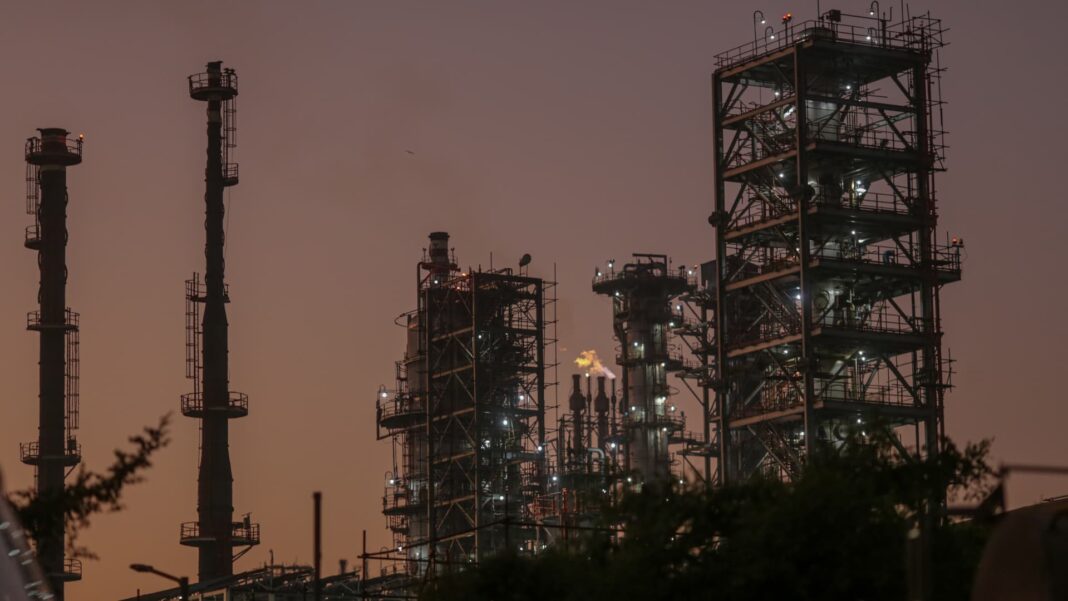
An oil refinery, operated by Bharat Petroleum Corp., in Mumbai, India.
Dhiraj Singh | Bloomberg | Getty Images
State-owned refiners in India are still buying Russian oil, even as New Delhi seeks relief from U.S. tariffs imposed for those purchases, according to energy analysts.
The U.S. imposed a “secondary” 25% tariff on Indian goods in August, citing New Delhi’s continued imports of Russian crude. Washington also sanctioned Russian oil companies Lukoil and Rosneft in late November.
On Sunday, U.S. Senator Lindsay Graham claimed that India’s U.S. ambassador, Vinay Mohan Kwatra, had asked him to urge President Donald Trump to lift these tariffs, arguing that New Delhi has reduced its purchase of Russian oil.
While India’s overall demand for Russian crude fell in December, analysts said the decline was largely driven by reduced buying from Mukesh Ambani-owned Reliance Industries, which had been a major importer before the U.S. sanctions on Lukoil and Rosneft took effect in late November.
State-owned refiners, known as public sector undertakings (PSUs), have offset part of that drop for Russian oil, analysts added.
State-owned Indian firms like the IOC (Indian Oil Corporation) and BPCL (Bharat Petroleum Corporation) “have continued to buy Russian crude for future delivery, through non-sanctioned suppliers,” said Muyu Xu, senior crude oil analyst at tanker tracker firm Kpler.
BPCL declined to comment, while IOC and Hindustan Petroleum Corporation, as well as the Indian Ministry of Petroleum and Natural Gas did not respond to requests for comment from CNBC.
India has faced sustained pressure from the U.S. to cut back on Russian oil imports, an economic lifeline that enables Moscow to withstand Western economic sanctions over its war against Ukraine.
“Despite declining aggregate imports, PSU refinery intake of Russian crude has remained resilient, highlighting a redistribution rather than a collapse in demand,” said Rystad Energy’s Pankaj Srivastava.
Rystad estimates India’s Russian crude imports fell by about 300,000 barrels a day since November to 1.7 million barrels on a sequential basis.
However, a “modest recovery” to 1.8 million barrels a day is expected in January, it said.
“Public sector refiners continue to process Russian crude with a slight upward trend, driven by domestic fuel demand and pricing economics,” said Srivastava, the senior vice president of commodity markets at Rystad Energy.
Kpler’s data also showed a decline in India’s import of Russian oil.
“India’s imports of Russian crude fell by 595 kbpd month-on-month in December, dropping to 1.24 mbpd—the lowest level since December 2022,” according to Kpler.
On Sunday, speaking to reporters aboard Air Force One, Trump said the United States could raise tariffs on India if New Delhi fails to curb purchases of Russian oil.