Honeywell Technologies CEO Vimal Kapur says AI isn’t about replacing industrial workers. What it will do, though, is force them to quickly adapt as the technology transforms how companies operate.
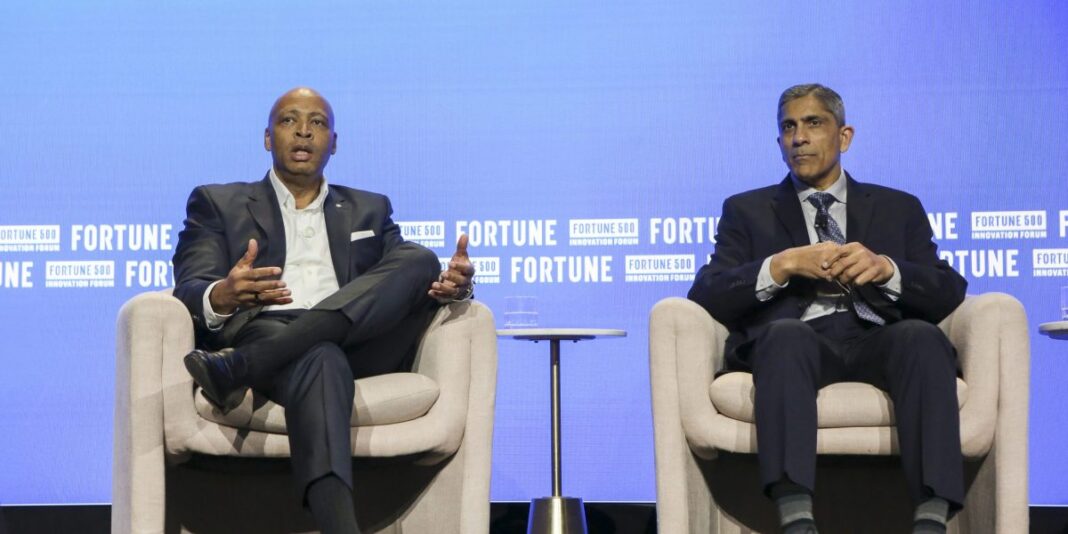
“It’s about making humans more productive,” Kapur said Monday at the Fortune 500 Innovation Forum in Detroit.
Sharing the stage with Kapur was C.H. Robinson CEO Dave Bozeman, whose 120-year-old logistics company has already seen productivity gains of more than 60% since the end of 2022 as it uses AI and other technologies to automate repetitive tasks.
The two CEOs spoke about how AI is transforming some of America’s largest industrial companies, even as the technology fuels anxiety among employees worried their jobs could eventually disappear.
Both CEOs told Fortune’s Andrew Nusca that AI has the potential to make workers more productive, but that it will also require them to learn new skills and rethink how they’ve traditionally done their jobs.
Changing jobs
Honeywell is no stranger to change. The industrial giant has operated across a wide range of industries during its 140-year history. In the past two years alone, it has spun off both its advanced materials business and aerospace division to focus on industrial automation. Now, Kapur is using AI to transform its business once again.
While much of the attention around industrial automation has focused on AI-powered humanoid robots, such as Tesla’s Optimus, and its potential to replace factory workers, Kapur sees a broader opportunity to help employees do their jobs more effectively.
He argued AI could be especially useful for companies struggling to find enough skilled industrial workers, particularly in jobs requiring hands-on labor. Rather than replacing those employees, AI could supplement their expertise and allow them to perform tasks that could require more specialized training.
But making workers more productive doesn’t stop at just implementing the technology, Kapur added. Businesses need to redefine entire processes, and then make sure employees have the necessary skills to get the job done.
“Next 18 to 24 months, we all have to reskill ourselves. And we take it very seriously because it’s not a small change for myself or for the entire organization,” he said.
AI productivity
At C.H. Robinson, Bozeman said the company is employing AI agents to take over tasks that previously required employees to manually review millions of transactions.
In its “order-to-cash” process, which covers everything from processing customer orders to collecting payments, C.H. Robinson has developed specialized AI agents capable of generating freight quotes, processing shipment orders, and scheduling pickups and deliveries rather than relying on a one-size-fits-all AI system.
That has allowed employees to spend less time on repetitive administrative work and more time solving complicated supply-chain problems for customers, Bozeman said.
“Our people, when they look at it, do they want to do those mundane tasks every day? No, they don’t,” he said.
This kind of automation is especially important as C.H. Robinson prepares to expand through a key acquisition. The company announced in October that it was acquiring rival freight broker RXO for $5.8 billion. The deal, expected to close in the first quarter of 2027, combines two of the country’s largest freight brokerages.
Bozeman said the acquisition is “not just a scale play,” but also an opportunity to bring C.H. Robinson’s technology and operating model to a much larger business.
The company expects to generate approximately $300 million in annualized cost savings within two years of the deal closing, it said in an October announcement, in part by applying its AI-powered operating model, Lean AI, to RXO’s operations.
Learning to adapt
Still, changing how employees work isn’t always easy, especially when workers wonder whether implementing technology to make them more productive could actually do away with their own jobs.
Kapur said he heard the same concerns in the 1980s, when some warned computers would replace engineers. Instead, the technology changed the way engineers worked without eliminating the profession.
For Kapur, creating more AI-fueled efficiencies means company leaders must evolve alongside their employees. In other words, he must also commit to upskiling.
“I personally took training on Copilot because if you don’t learn yourself and immerse yourself, you can give a lot of free advice, but you don’t know what the change really means,” he said.