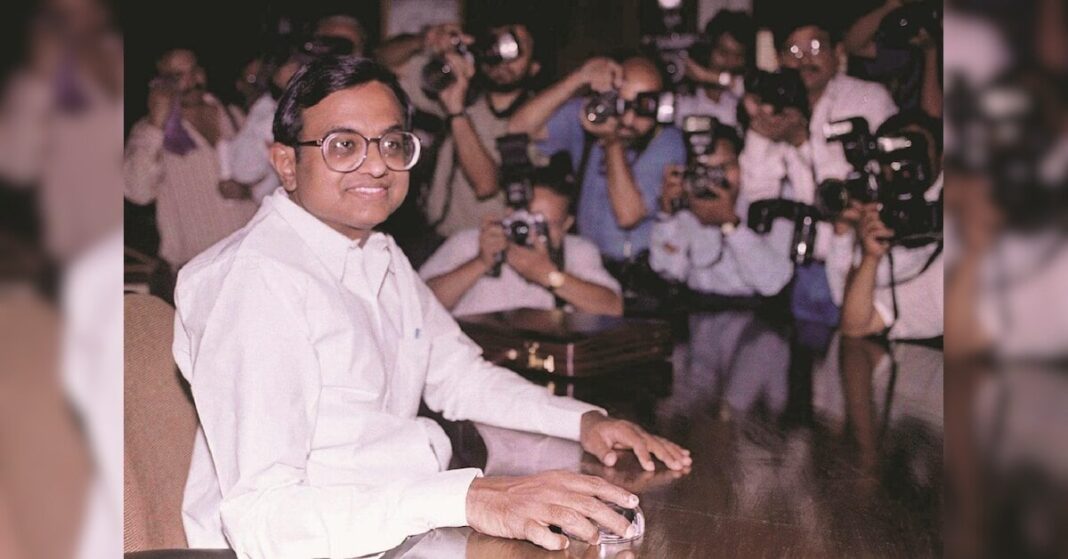
P. Chidambaram, who first became a Parliamentarian in 1984, served as India’s minister of state for commerce with independent charge in P V Narasimha Rao’s government when India rolled out the 1991 reforms. A new trade policy and industrial policy were part of that reform package. Chidambaram reflects on what led to the hurried rollout of the 13-point trade policy on July 4, 1991, before the reform Budget was presented by Manmohan Singh later that month. In an interview, Chidambaram, who subsequently served as finance and home minister during the Congress-led United Progressive Alliance’s tenure, tells Asit Ranjan Mishra and Gireesh Chandra Prasad that he believes India needs to usher in more competition and work with other nations to revive the World Trade Organization (WTO) for a more open global trading system. Edited excerpts:
You were the Commerce Minister during the 1991 reforms. How was the trade reform package put together within a fortnight of the Narasimha Rao government taking charge on June 21?
I presented a small package on July 4 and the Union Budget was presented on July 24. The story began earlier, when the rupee was devalued on July 3. The Prime Minister told me about the strong opposition within the party to the proposed two-step devaluation, wanting to stop the second step.
I replied that he must have discussed it with the Finance Minister, Manmohan Singh, and approved the devaluation. He didn’t deny it, but said there was a lot of opposition. The Prime Minister asked if the second step could be stopped, and asked me to speak to Singh. The first step was done the previous day, and the second step was to be done after a day.
I went across to the Finance Minister’s office and conveyed to Singh, “You know that there is a murmur about the devaluation. The PM is also concerned. Can we postpone the second step?”
The Finance Minister hedged. He said, “I don’t know. I have left it to the RBI (Reserve Bank of India), and I’ll find out from the RBI.”
By the time I returned to the PM, the second step had been done. Singh apparently told the PM, “I called C Rangarajan (then deputy governor of the RBI)… I asked him about the position. Rangarajan said he had jumped. That was a code word, and the devaluation had been done.”
So I told the PM, “It’s been done. That’s the end of the matter. We have to move on.”
After the devaluation, Singh called me. He must have had a talk with Montek Singh Ahluwalia; they were very close. He told me that now that devaluation has been done, the cash compensatory support for exports should be withdrawn.
I replied that I agreed with the logic, but no Commerce Minister can start his tenure by withdrawing the only support offered to exporters. They will say I am anti-exporter. So I can’t do that. We have to make a package and do it, I said.
Montek Singh said there was logic in that. We went to Rao, who I knew more closely than Singh, from my Youth Congress days. I said the Finance Minister wanted me to withdraw the cash compensatory support and that I understood the logic, but it was hard to do. “It can be done, but it has to be done as a package,” I said. The PM agreed.
So Montek Singh and I drafted the package, one element of which was withdrawing the cash compensatory support. Among others were the dual exchange rate and the EXIM scrips (a government document issued to exporters).
We put together a package and then we took it to the Finance Minister. Singh read through the package and accepted it. We went back to the PM, who came to the drawing room. He had just had a shower and was wearing a lungi and a vest. He asked if I had signed it, to which I said, “Yes.” He looked at Singh and asked, “Have you signed?” He said, “Yes.” He then took the file and signed it.
That’s how the trade reforms were done.
There was no bulky file, no notes, no under-secretary or deputy secretary. The three principals decided on a policy, and that is how the trade policy was made, and that is how policy should be made. All the advisors and IAS officers should give inputs to the principals to decide the policy. The policy must be decided and sent down. It can’t involve writing innumerable notes. That’s where policy fumbles and is derailed.
P Chidambaram, Former finance minister | File photo: Reuters
Was some groundwork done already by the previous government?
There was an ‘M document’. Montek had coined the phrase “exim scrips”. What is relevant is the final policy package, its economic validity, and its political saleability. The economic validity of the package was obvious. The political saleability is the way we packaged it.
Why was the trade reform presented first, then the industrial policy on July 24 forenoon and then the Budget that evening?
Because of devaluation. The cash compensatory support had to be withdrawn, therefore the mini-trade policy package was announced on July 4. Then the Industrial Policy Resolution next, then the Budget, and then the longer statement on the 13-point trade reforms was presented to Parliament on August 13.
Is there anything that you wanted to do but could not at that time?
Whatever we wanted to do, we did. We had to rewrite the entire EXIM (export-import) policy, which we did. We had to abolish the monopoly of the Coffee Board in procurement of coffee, which we did. Whatever agenda came up, we fulfilled it by and large in the first year.
Many believe Manmohan Singh is unduly credited with the 1991 reforms, whereas it was Rao’s astute political management that brought them about. Your thoughts?
Manmohan Singh was the technical brain behind it, the economist. He had reflected deeply about these matters for several years, especially when he was in the South-South Commission. The person most competent and suitable to politically steer the reforms responsibly was Rao. Without Rao, Singh could not have done these reforms. And without Singh, Rao could not have conceived of these reforms.
Yashwant Sinha, who presented the interim Budget in 1991 said most of the groundwork was ready before the July budget. Your thoughts?
Maybe it was all ready. Why didn’t they do it? Everything was arguably ready in petroleum, in energy, in roads. But somebody must have the courage to implement it and the political strength to own it.
After 35 years of reforms, we are still struggling to improve the share of manufacturing in our gross domestic product (GDP). On the other hand, China has had a meteoric rise. Where did we falter?
We have no successor to Manmohan Singh. For 12 years, this government (National Democratic Alliance) has not had a technical and economic expert of the calibre of Singh.
But the UPA was in power for 10 years up to 2014. Should it also not take a part of the blame?
Why don’t you go to 1947? That is the BJP’s language: “You have ruled for so many years!” Here we are only talking 1991 onwards. During 1991-96, we did a lot of reforms. We put India on the path of liberalisation and open economy, and that brought great benefits.
Then there was a six-year gap. We came back in 2004 with Singh as the PM, and I was the Finance Minister. My term was interrupted for three-and-a-half years by Pranab Mukherjee’s. When we were in office, we did a lot of reforms, and I have written a column listing all that took place.
You go through our 10-year record. Why we did not send a manned mission to space is not the question. We have to do the initial reforms. And the sequencing of the reforms follows its own logic.
Therefore, you can’t do everything on your first day. Look at the expansion of the stock market. We had to have depositories. We had to have a law for the Securities and Exchange Board of India (Sebi). Sebi needed to pass several regulations for different sectors of the stock market. Who did all of that? Today, a share transfer can take place in 10 seconds because of dematerialisation. Who did that?
I can go into each sector. Now, insurance has seen explosive growth. We opened up insurance to private players. We allowed foreign insurers to come. We proposed 24% FDI (foreign direct investment). But BJP strongly, stoutly opposed it. Then we offered to start with 10% FDI. They declined. Then they opened up. Now, slowly, 100% FDI has been allowed. There was political resistance for every opening up.
What are five structural reforms that India needs right now?
I am not advising this government because this government will reject it. Let the people elect a non-BJP government and I will advise.
Multilateralism in global trade has given way to aggressive tariffs and protectionism, while countries are exploring bilateral trade deals. What should our approach be in the current environment?
The world is moving in reverse gear; it is going back to protectionism. We have also gone back to protectionism. Our anti-dumping duties, tariffs, quality control orders are all protectionist. What else are they?
We should open up more, but then we can’t open up unilaterally. It takes two hands to clap. If other countries don’t open up, we are in a bind. We can’t open up unilaterally.
We have to revive the WTO and dispute resolution, which are practically dead. We have to get all the other countries to put pressure to breathe life into the WTO, which must function. Unless there is a rules-based order, we can’t unilaterally open up. But that is a direction I believe we should go, and the world should go.
Why do you think private capital expenditure hasn’t picked up despite the government giving so many incentives?
Because of this government. Private capital is trapped between four barriers: Regulation, investigation/enforcement, crony capitalism and bureaucratic hurdles. Have you seen the new regulations and rules made every day by various ministries? With these regulations, who will bring money into India?
Then there is investigation at the drop of a hat. There are bureaucratic hurdles. No minister, according to anecdotal evidence, is in charge of his ministry. Everybody looks to the Prime Minister’s Office (PMO) for signals and acts only when the PMO signals.
Centralism dominates this government. It’s all centralised in the PMO. And then there is crony capitalism. I can understand if it is a capitalist economy. A capitalist economy has many drawbacks. Therefore, we don’t support a fully capitalist economy. But this is crony capitalism, which is worse.
There are several sectors that are either monopolies or oligopolies. Telecom is an oligopoly. Cement is becoming an oligopoly. That is true for airlines, ports and petroleum sectors.
In fact, the space for competition has shrunk. The Competition Commission of India (CCI) has lost all its teeth. Show me one merger or takeover in recent years that the CCI stopped. There is less competition in this country than there was 10 years ago and it is becoming lesser and lesser.
Fifty per cent of the population that is at the bottom holds 10% of India’s income. The top 1 per cent holds 10 per cent of India’s income and the top 10 per cent holds 25 per cent. Income inequality has increased.
Wages have not risen. Rural wages have stagnated. The growth was 0.7 per cent last year. For casual and irregular labour, the wage growth is negative. For regular salaried employees, the wage growth is 0.4 per cent. If the economy is growing at 6.5-7 per cent, why don’t wages increase?
This government has no economic philosophy. It only believes in slogans and acronyms like “Make in India” and “PLI” (production-linked incentives).
Read the report of the Comptroller and Auditor General of India on skill development. It says the entire effort is a complete disaster.
In this year’s Independence Day speech, the Prime Minister said this government’s reforms are borne of conviction, not compulsion. What would you say to that?
I don’t think the Prime Minister has the conviction that India needs economic reforms. When he was Chief Minister, he, like many other CMs, believed in a closed and regulated economy. He may have changed over the past 12 years. He may have understood that we need to open up. But which sector has he opened up in the last five, six years? In fact, competition in several sectors that I’ve mentioned, has reduced. Lack of competition is the enemy of a free economy. We need a free and competitive economy. Show me which sectors are competitive. Foreign investors will not come into India if they fear that one day they will be driven out, and that is a real fear. There are several international telecom companies in the world much larger than Airtel and Reliance Jio. Why are they not here? Why is Vodafone, a large global telecom company, not in India in a more visible and more dominant way?