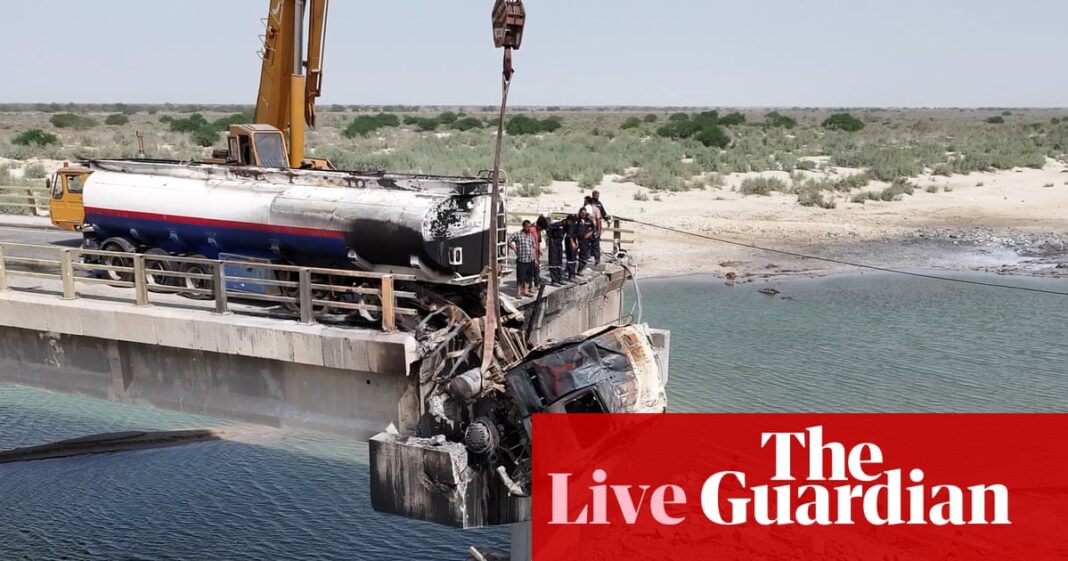
Kuwait reports another Iranian attack on a power and water plant
Kuwait’s ministry of electricity, water and renewable energy said a power and water distillation plant was attacked by Iran for the second time in two days, causing a fire in some of its facilities.
In a statement posted to social media, the ministry said the attack impacted a “large number of electricity generation units”, triggering emergency plans to mitigate the effects and “maintain the stability of the electricity grid”.
It added that firefighters were working to extinguish the fire while the extent of the damage is being assessed.
As my colleague Donna Ferguson notes in this story, Kuwait on Saturday accused Iran of targeting civilian sites and vital infrastructure in the country, such as a power and water desalination plant.
Kuwait, which is extremely arid, relies on desalinated water for about 90% of its drinking water, so is extremely vulnerable to attacks from Iran.
Key events
Further to that last post, Lebanese officials said president Joseph Aoun is due to meet with Donald Trump on Tuesday in Washington.
While in Washington, Aoun planned talks “on the situation in Lebanon and ways to strengthen the ceasefire” as well as on “the withdrawal of Israel from the Lebanese regions it occupies,” his office said earlier.
Rubio meets with Aoun to discuss trilateral framework
As we reported earlier, US secretary of state Marco Rubio met with Lebanese president Joseph Aoun in Washington on Sunday to discuss the implementation of the US-backed trilateral framework, hailing the country for its “move towards peace” after the latest round of Lebanon-Israel talks.
Rubio “commended the courage of the Government of Lebanon, under President Aoun’s leadership, for their determined effort to reclaim Lebanon’s sovereignty, disarm Hezbollah and dismantle its terrorist infrastructure, and move towards peace,” the US state department said in a statement.
It added that Rubio reaffirmed the US’s commitment to supporting the implementation of the framework.
The UN’s nuclear watchdog called for restraint on Sunday after Iran’s Atomic Energy Organization said the United States had attacked an under-construction nuclear power plant in the country’s southwest.
The US and Iran have been trading escalating attacks for days, and Washington carried out fresh airstrikes on Sunday to “punish” Iran for the deaths of two US service members in Jordan on Friday – its first reported losses since the return to open hostilities in the war.
Tehran’s Atomic Energy Organization said US forces “in an aggressive and brutal act contrary to international law, attacked the under-construction Darkhovin nuclear power plant… with a number of projectiles on Sunday”, according to a statement carried by state TV.
As we reported earlier, the UN’s International Atomic Energy Agency (IAEA) said it was looking into the reports, noting the plant “is in the very early stages of construction and contained no nuclear material when last visited by the IAEA”.
While the incident “is not believed to pose any radiological risk”, IAEA director Rafael Grossi reiterated his “call for military restraint in the vicinity of all nuclear-related sites”, the agency said, in a post on X.
The US secretary of state, Marco Rubio, met with Lebanese President Joseph Aoun in Washington on Sunday, a state department official told the AFP news agency.
It is the first trip to Washington by a Lebanese head of state since Michel Sleiman was received by former US president Barack Obama in 2009. The Lebanese president’s office said Aoun would meet Donald Trump on Tuesday.
Aoun, who served as the commander of Lebanon’s US-backed army before being elected president last year, will reportedly present a plan to Trump on how to disarm Hezbollah and secure Israel’s withdrawal from southern Lebanon. Hezbollah has firmly rejected the government’s direct talks with Israel and efforts by the state, which it operates independently of, to strip it of its arms.
As well is killing many Lebanese civilians in airstrikes across the country, the Israeli military has destroyed dozens of villages in the areas it occupies, something Human Rights Watch said could amount to a war crime. Hundreds of thousands of Lebanese people remain displaced from their homes.
Israel has occupied large swathes of south Lebanon in what it calls a “security zone” and says it is trying to protect its northern communities from the threat of Hezbollah.
Lebanon was drawn into the war when Hezbollah fired rockets at Israel on 2 March to avenge the US-Israeli killing of Iran’s former supreme leader in Tehran in late February.
More than 50 people have been killed in US attacks since the beginning of July, Iran’s Fars news agency has cited the country’s health ministry as saying.
The International Atomic Energy Agency (IAEA) has confirmed it is “looking into reports” of an overnight attack on an under-construction nuclear plant in Darkhovin, in Iran’s southwestern Khuzestan province (see this post for more details).
“The facility is in the very early stages of construction and contained no nuclear material when last visited by the IAEA,” the UN agency said in a statement.
The IAEA said the reported attack is “not believed to pose any radiological risk” but stressed that the agency’s director general, Rafael Grossi, urges for “military restraint in the vicinity of all nuclear-related sites”.
Iran’s Atomic Energy Organization said earlier today that the US attacked an under-construction nuclear power plant site Khuzestan province with multiple projectiles.
Trump urges Republicans to add Iran to Russian sanctions bill
The US president, Donald Trump, has said the Republican party should add Iran to the Russian sanctions bill, arguing that this is what Lindsey Graham, the late Republican senator and his close political ally, wanted.
“That’s what Lindsey wanted to do, and it was going to happen. IMPORTANT!!!” he wrote on the Truth Social platform in a brief post.
The bill would allow Trump to place 100% tariffs on goods coming from the top five buyers of Russian oil and natural gas.
The legislation is meant to cut revenues from the sale of Russia’s energy for its war on Ukraine. Republicans and Democrats have both indicated that the bill could become law over the summer.
The White House had previously suggested the scope of the bill could be widened to include Iran and Hezbollah, the Lebanese militant group Tehran has supported and funded for decades.
Earlier this month, the US reimposed sanctions on Iranian oil sales in response to attacks on commercial ships near the strait of Hormuz. This was after the US agreed to a 60-day sanctions waiver and promised to unfreeze Iran’s assets under the now collapsed memorandum of understanding. The waiver was welcomed in Iran, where US sanctions have long crippled the economy.
Sirens have sounded in the Jordanian capital Amman on Sunday, an AFP correspondent said, as the United States and Iran exchanged drone and missile attacks.
Jordan’s state-run Al-Mamlaka channel also reported that “sirens have been activated in different parts of the kingdom”.
IDF says missiles launched from Iran toward Jordan and spillover into Israeli territory possible
The Israeli military said Sunday it had identified missiles launched from Iran towards Aqaba in Jordan, after Jordan’s government denied the city’s airport and seaport were evacuated over a threat.
“A short while ago, the IDF identified the launch of missiles from Iran toward the city of Aqaba in Jordan, adjacent to Israeli territory,” the military said. “It is possible that as a result of the fire, there will be spillover into Israeli territory.”
Kuwait reports another Iranian attack on a power and water plant
Kuwait’s ministry of electricity, water and renewable energy said a power and water distillation plant was attacked by Iran for the second time in two days, causing a fire in some of its facilities.
In a statement posted to social media, the ministry said the attack impacted a “large number of electricity generation units”, triggering emergency plans to mitigate the effects and “maintain the stability of the electricity grid”.
It added that firefighters were working to extinguish the fire while the extent of the damage is being assessed.
As my colleague Donna Ferguson notes in this story, Kuwait on Saturday accused Iran of targeting civilian sites and vital infrastructure in the country, such as a power and water desalination plant.
Kuwait, which is extremely arid, relies on desalinated water for about 90% of its drinking water, so is extremely vulnerable to attacks from Iran.
Iran says US attacked under-construction nuclear power plant
Iran’s Atomic Energy Organization said earlier today that the US attacked an under-construction nuclear power plant site in Khuzestan province, in the country’s southwest.
US forces “in an aggressive and brutal act contrary to international law, attacked the under-construction Darkhovin nuclear power plant… with a number of projectiles on Sunday,” the organisation said in a statement carried by state TV.
Construction of the nuclear power plant reportedly began four years ago. We have not been able to verify this report and the US has not commented on the reported attack.