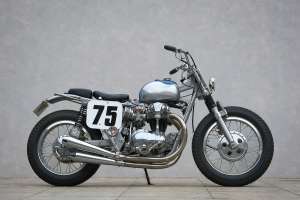
Kawasaki’s W series has earned a distinct level of respect among vintage motorcycle enthusiasts. Even in stock form, they carry a mechanical elegance that rivals traditional British iron, but benefit from oil-tight Japanese engineering. For builder Jay Shang, the W series is an outright obsession. His personal garage houses a W800, a W1 and the 2003 W650 you see here. But despite his deep appreciation for factory Kawasaki aesthetics, a fateful trip to California completely derailed his plans for the 650.
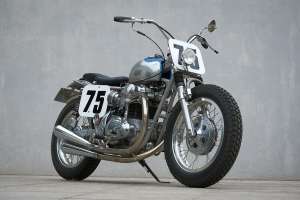
While traveling the West Coast, Shang walked through the doors of Dan Rouit’s Colvis Flat Track Museum. Greeted by more than 100 vintage flat track race bikes preserved in their rawest forms, Shang was taken aback. “Every one of those machines felt like a beast, sitting there silently, yet still incredibly intimidating and awe-inspiring,” Shang recalls. Before he even left the building, Shang made a quiet promise to himself: he would build a flat tracker of his own.
That promise kicked off a relentless four-year process of sketching, fabricating, cutting and refining. The goal was straightforward but more mechanically demanding than is immediately evident. Shang wanted to capture the aggressive, stripped-down essence of a vintage tracker without sacrificing the necessary components for street legality.
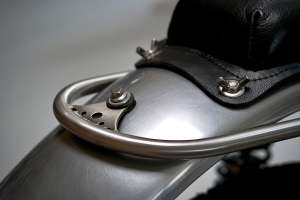
The project was dubbed ‘Moana’ as a nod to Shang’s love for the ocean, but he notes that the ocean also symbolizes a father’s love for his child in Chinese culture. “I believe a bike carries warmth and I hope for my son to see it when he grows up,” Shang says. Work started with a complete teardown of the 2003 Kawasaki W650. While the factory frame and parallel-twin engine form the core of the build, virtually everything else was custom-built. Shang started by axing the rear section of the frame and finished it with such precision that you’d have to compare it side-by-side with stock to notice. A small-diameter tubular section now supports the polished rear fender without adding visual weight, and even includes provisions for a functional license plate bracket.
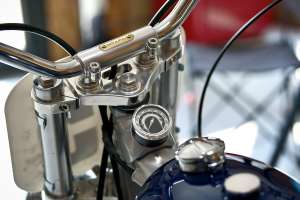
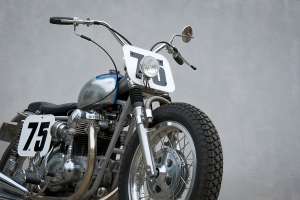
Sitting atop the backbone is surely the most polarizing piece of the build—the fuel tank. It’s completely handmade, and rounded to resemble “a smooth, rounded stone—something you might find by the sea,” Shang says. It wouldn’t work on a lesser build, but I’ve grown to like it here. Shang devised a threaded insert system to mount the tank securely without interrupting the lines, and it wears a deep ocean-inspired paint job that contrasts sharply against the raw mechanicals below.
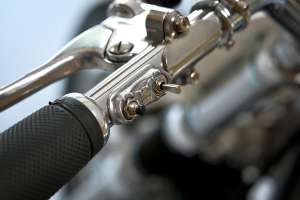
The front end required a dramatic attitude adjustment. Shang ditched the factory yokes in favor of custom CNC-machined upper and lower triple clamps. Since retaining the front fender was never an option, Shang whipped up a functionally pure front fender brace, comprised of a curved bar and clamps on the fork lowers. He then sourced a wide, aggressive handlebar directly from Brat Style in Japan and high-end hardware from Motor Rock—including the handlebar switches, mirrors, side stand and foot pegs. These fine details keep the bike grounded in its intended era.
Fans of the W650 will immediately notice something’s missing from the front end—a brake disc. Shang appreciates the classic look of drum brakes and tossed the OE front hub in favor of a drum from a Yamaha SR400. If you’re shouting in the comments that this is a downgrade in brake performance, I’ll remind you that race bikes have no front brake at all. He laced the wheels with custom H-profile aluminum rims wrapped in classic Firestone rubber. Completed, it’s a flawless wheelset for those who know.
The W650’s faithful parallel twin remains internally stock but received upgrades in aspiration. Shang binned the factory CV carburetors and installed a pair of Keihin CR Special W650 carbs—high-performance, smooth-bore replacements designed for instant throttle response.
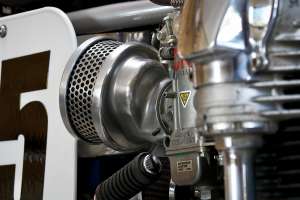
Rather than off-the-shelf pod filters, he designed a pair of custom air filters and had them CNC-machined. With the perfect finish, you’d easily mistake them for vintage cast pieces.
Shang reports that getting the exhaust right was the most grueling phase of the four-year build. He fabricated, scrapped and redesigned the pipes system multiple times before arriving at this tasteful, sweeping configuration. The setup has such elegant lines; we’re certain W650 owners will be asking for quotes.
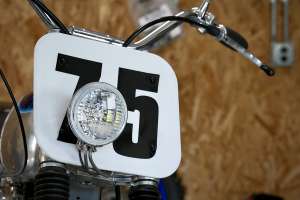
The electrical system now relies on a Motogadget mo.unit tucked neatly out of sight. A tiny lithium battery hides inside a custom-fabricated battery box, ensuring the open triangle along the left side remains uncluttered. Instrumentation consists of a minimalist Motogadget gauge, while an ultra-bright Motogadget taillight keeps the rear end street-legal without ruining the lines. Up front, a compact headlight fulfills the requirement for city riding.
Sometimes the best bits are the ones you miss at a glance. Shang hunted down a rare pair of discontinued vintage Redwing rear shocks to handle suspension duties out back, and they look showroom fresh. On the left side of the bike, a custom-fabricated toolbox fills the void. It wears a vintage ‘170’ emblem salvaged from a Meguro Z7 engine—a brilliant nod to Kawasaki’s early manufacturing history, as the Meguro brand eventually became part of Kawasaki.
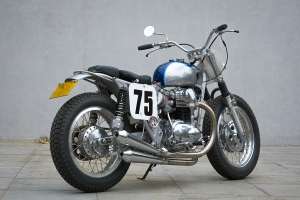
Completed, Moana is a bike that doesn’t scream for attention. The project is a tasteful backdating of a niche model that perfectly encapsulates an era of twin-cylinder flat-track performance. It’s a bike that catches your attention in the nuts and bolts, and rewards a deeper look. It honors the dirt oval but lives for the asphalt.
Photos by Jay Shang