When Royal Enfield introduced the Hunter 350, it quickly became a darling of the urban riding scene. Powered by a 349cc air-cooled, single-cylinder engine, it produced 20 horsepower and was equipped with electronic fuel injection, a slip-and-assist clutch, and progressive rear suspension. It proved to be a wildly capable platform despite its small capacity. It was designed to navigate tight city streets with ease, capturing the spirit of modern youth culture.
To celebrate that very community, Royal Enfield launched the Hunterhood festival, a vibrant event that traveled across major Indian hubs such as Mumbai, Delhi, Shillong, Lucknow, and Kochi. The festival was a sensory overload of action sports, live music, art workshops, and streetwear flea markets. Naturally, the factory needed a custom motorcycle that perfectly encapsulated that youthful, street-culture energy. Enter Garuda Machina.
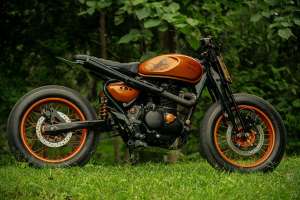
Based in Nagpur, Maharashtra, Garuda Machina is a custom motorcycle house that has built a stellar reputation for blending traditional Indian charm with modern design and mechanical precision. Founded on a deep passion for clean lines and uncompromised aesthetics, the shop constantly strives to balance form and function. When Royal Enfield commissioned them to build a centerpiece for the Hunterhood festival, the team knew exactly where to draw their inspiration. They named the project ‘Pench,’ a brilliant double entendre. In Hindi, ‘pench’ translates to ‘bolt’ or ‘screw,’ a nod to the mechanical nature of the craft. But more importantly, Pench is the name of the famous tiger reserve located in Nagpur. As the tiger capital of India, Garuda Machina wanted to create a tracker that stood as a rolling symbol of their city.
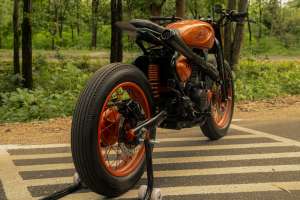
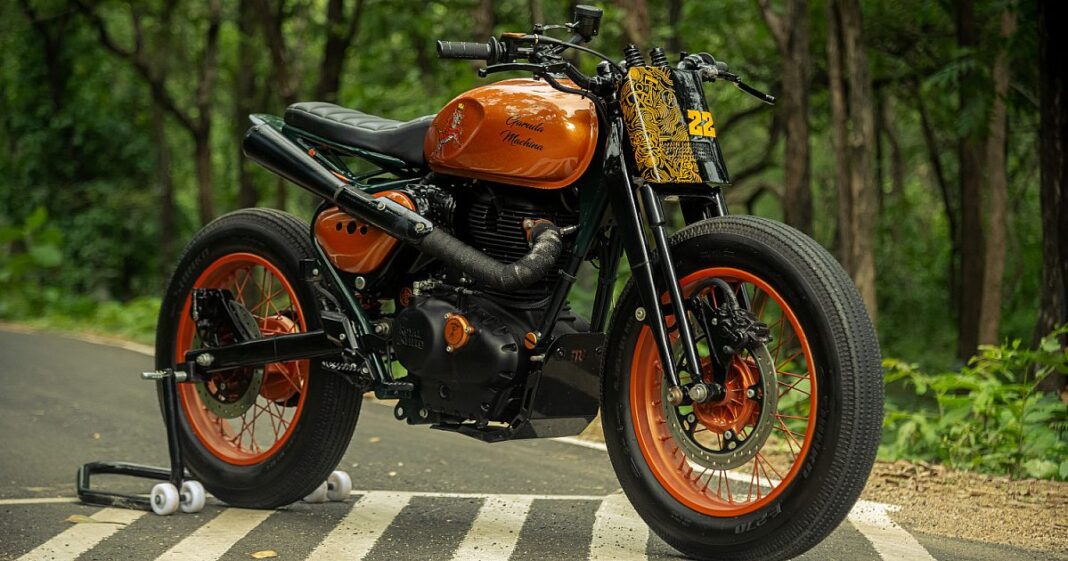
Inspired by the concept of a sleek, aggressive apex predator, the crew opted for a street tracker silhouette defined by clean, sweeping lines. The transformation began at the rear of the motorcycle. Garuda Machina stripped away the bulky factory seat and the heavy stock subframe. In its place, they fabricated a custom trellis-style subframe designed to support a heavily abbreviated, ultra-thin tracker seat. While this modification inevitably sacrificed some of the plush comfort associated with the stock Hunter 350, it successfully achieved the clean, minimalistic aesthetic the builders were chasing.
To further declutter the rear end, the stock twin-shock suspension setup was discarded. The team engineered a modern monoshock conversion, which required updates and bracing to the factory swingarm, transforming the Hunter’s stance and handling dynamics.
Moving to the front of the motorcycle, Garuda Machina made a bold and highly unconventional design choice. For a motorcycle that boasts modern engineering and nimble geometry, abandoning the factory telescopic front forks in favor of a vintage-style springer front end was a fascinating twist. Springer forks are typically reserved for choppers or period-correct bobbers, rarely finding their way onto modern street trackers. Yet, against all odds, the mechanical complexity of the springer complements the aggressive, stripped-down nature of this particular build.
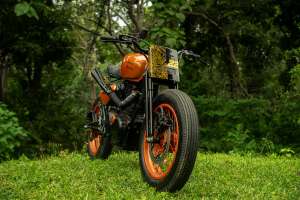
That vintage front end works in harmony with the wheel-and-tire package. The builders laced up a set of 18-inch rims and wrapped them in heavily treaded Shinko E270 sawtooth tires. Measuring at 4.5 inches wide, the bulbous rubber provides a retro, muscular look to the motorcycle. While wrapping a nimble city bike in such heavy, vintage-style rubber might slightly hamper its overall cornering performance, the visual payoff is undeniable.
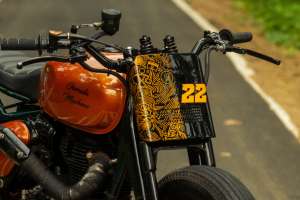
Tying the front end together is a brilliantly executed custom tracker number plate. It delivers that classic dirt-oval racing vibe perfectly suited for a street tracker, but with a clever twist. Mounted behind the number plate is a high-intensity LED headlight that illuminates the road ahead by shining through a series of strategically drilled cutouts in the aluminum plate. It is a masterful blend of old-school racing aesthetics and modern illumination.
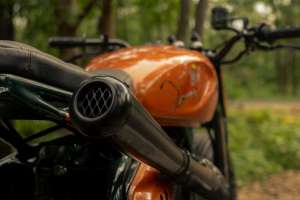
While much of the motorcycle was cut, chopped, and replaced, the stock Royal Enfield fuel tank was retained, maintaining the 350’s silhouette. However, its finish is anything but factory. The tank was covered in a burnt metallic orange, directly honoring Nagpur’s famous moniker as the ‘Orange City.’ Adorning both sides of the tank are hand-painted Warli art inspired pouncing tigers, a traditional, geometric art form created by the indigenous Warli people of Maharashtra. This burnt-orange hue was woven throughout the rest of the motorcycle, providing a striking contrast against the blacked-out engine, frame, and springer front end.
At first glance, Pench is an exercise in juxtaposing styles, blending a modern monoshock and EFI engine with a vintage springer fork and sawtooth tires. But beneath the surface, this motorcycle represents something much deeper. It is a heartfelt, rolling homage to the builders’ home.