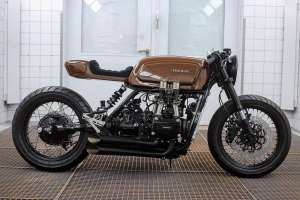
In 2018, Honda launched the sixth-generation Gold Wing. Like the previous iterations, it reshaped expectations for full-fairing, long-haul touring. Exceptional in design and execution, few machines make lighter work of a cross-country excursion. But that is not exactly what Honda’s designers set out to build back in the early 1970s. Originally, they envisioned a high-speed tourer valued for its performance and handling nearly as much as its highway prowess.
Sporting bulletproof four-cylinder boxer engines, the custom scene has long embraced the challenge of restoring the GL1000’s sporting intentions. It is a notoriously difficult machine to get right. Early Gold Wings were not built like standard motorcycles of the era. They feature complex frames, shaft-driven rear ends and real fuel tanks buried deep under the seat. For too long, Gold Wing customs came with an asterisk. Ralf Mundhenk’s 1976 GL1000 café racer makes no compromises.
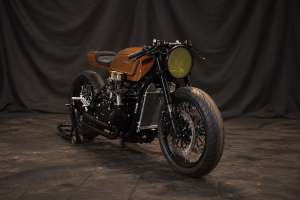
Based in Hamburg, Germany, Ralf and his crew—known locally as the Donner Buddies or the Club der Denker (Thinkers’ Club)—spent four years meticulously overhauling the machine. The project began in 2022 with a battered blue donor bike sourced in Berlin for €3,000. It was ugly, tired and begging for a complete teardown.
The crew stripped the Honda down to its absolute bare essentials. They retained only the frame, wheel hubs, steering head, swingarm and engine. Everything else went into the scrap bin.
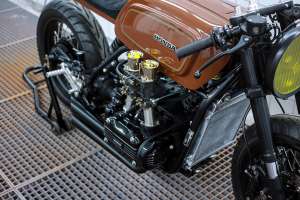
Their philosophy was simple: no off-the-shelf bolt-ons, no mimicking current trends and no rushing the process. They focused heavily on reshaping the rear end, fabricating bespoke bodywork and extracting the visceral sound of the flat-four motor.
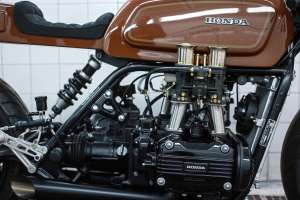
Horsepower was never the primary objective, but mechanical reliability was non-negotiable. The original engine received a comprehensive rebuild. To feed the refreshed boxer, Ralf ditched the complex factory carburetors in favor of 40 mm Weber Black Edition downdraft units mounted on custom-fabricated stainless steel intake manifolds. A scratch-built exhaust system ensures the GL1000 barks with the aggressive tone only a flat-four can produce.
With the boxer sorted, it was time to shift focus to the Gold Wing’s ungainly frame. The front end now utilizes forks from a Suzuki GSX-R 750 that have been shortened by 70 mm to level out the stance. Braking is handled by 300 mm rotors squeezed by the Suzuki’s six-piston calipers. Mundhenk retained the factory Honda front hub but machined a custom axle adapter to marry the disparate parts perfectly.
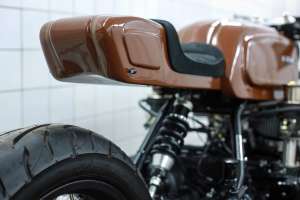
Out back, the factory twin-shock setup was entirely abandoned. Converting a shaft-driven GL1000 to a monoshock is a monumental headache when you’re unwilling to compromise on aesthetics. “Let’s just say we spent some serious time and money figuring out what worked and what didn’t,” Ralf quips. The team built a custom cantilever system that mounts the shock perfectly parallel to the frame—a nonnegotiable for the Club der Denker. The tightly packaged setup and the resulting open-air space under the saddle immediately set this Gold Wing apart from the herd.
Rolling stock consists of an 18×4-inch front and an 18×5-inch rear rim, laced to the original hubs with heavy-duty stainless steel spokes. They run a 130-section Dunlop Elite 4 up front and a 160-section Dunlop Arrowmax out back. Every rolling component was blacked out in a satin powder coat.
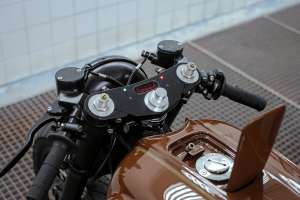
With the chassis sorted, Ralf and his crew turned their attention to bodywork. The OE Honda fuel cell, and the void it lived in, are gone, and its replacement is effectively invisible. A custom-fabricated 8-liter stainless steel cell lives above the engine between the frame tubes. It’s concealed by the hollowed shell of a Honda CB750 Four F2 fuel tank, which hunkers down over the GL1000’s wide frame. Ralf and his crew swelled the sides to give it some extra flair, and the flush-mount fuel door provides access to the new cell.
Arguably more impressive is the tail section, which echoes the body lines set by the fuel tank. It’s entirely fabricated from scratch, and the underside is enclosed and bodyworked—meaning it looks just as good from the bottom. After endless debate over the color palette, the Club der Denker settled on a rich, period-correct Porsche brown from 1973. Finished with tasteful linework, it’s a subtle, grounded color that allows the mechanical details to command attention.
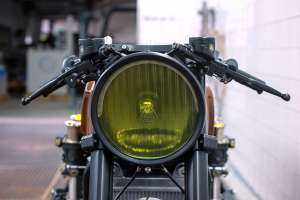
The crown jewel of the build sits dead center between the fork tubes. Over two years of hunting through European swap meets yielded an original 1930s headlight from a Horch—a prestigious pre-war German luxury auto brand that helped form the foundation of Auto Union and Audi. It’s a brilliant piece that works perfectly with the Gold Wing’s proportions. Behind it, a billet top clamp grips the GSX-R tubes with a Motogadget motoscope mini flush-mounted with four additional status lights.
It took four years of late nights and Johnny Walker for the Club der Denker to turn out a Gold Wing that defies the model’s lumbering reputation. It proves exactly what can be accomplished with a sheet of steel, an uncompromising vision and the stubbornness to see it through. Yet despite the relentless attention to detail, Ralf remains entirely pragmatic about the build.
“Hanging out with good buddies, working through problems together and watching something slowly come to life. That’s how we’ve always done things,” Ralf explains. “And to be honest, that’s a big part of why we do it.”
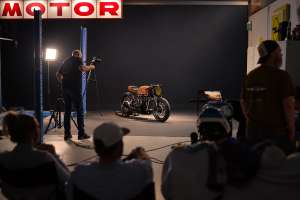
It is the ethos of a garage that values the work as much as the finished product. These are guys who would never cut a corner to save an hour, and this GL1000 is the rolling proof.
Photos by powermeierpictures