
Restoring classic off-road motorcycles is fiddly work. In addition to the standard stuff, you’re dealing with bikes that have been ridden hard in the dirt, and sourcing replacement parts is a completely different game than mass-produced street offerings. Eventually, you need to blow off some steam to remember why you got into this in the first place. For Mat and Jonathan at 1984SC, the perfect palate cleanser turned out to be a stripped-back Triumph desert sled drenched in matte black.
Based in Lyon, France, the workshop typically operates under strict vintage-preservation guidelines. They specialize in bringing classic trials and motocross machines back from the dead, with a stellar catalog that ranges from Matchless and Maico to Honda and Husqvarna. But for this in-house project, the team needed a break from rigid historical accuracy. They applied their meticulous mechanical standards to a freer concept built strictly for gravel.
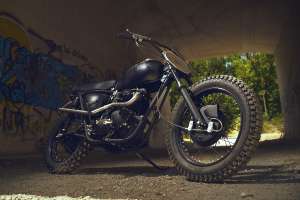
The crew started with a 1972 Triumph T120R Bonneville, a deliberate choice for a desert sled project. The early seventies marked the introduction of Triumph’s oil-in-frame chassis. It was a controversial engineering pivot that moved the engine oil reservoir out of a traditional side tank and directly into the large-diameter backbone of the frame. While traditionalists hated it at the time, that bulky perimeter skeleton provides an incredibly stout baseline for a dirt-focused build. The compact proportions and robust tubing make it an ideal candidate for heavy abuse.
It’s the exact formula that birthed the original British desert sleds. By the late 1960s, lightweight two-strokes were already dominating tight motocross tracks. But out on the sprawling expanses of the American West Coast, desert racers played a different game entirely. Crossing the Mojave required serious top-end speed and high-speed stability. Riders happily traded lightweight agility for the sheer brute force of a large displacement British twin. They stripped off the road gear, bolted on wide handlebars and held the throttle wide open.
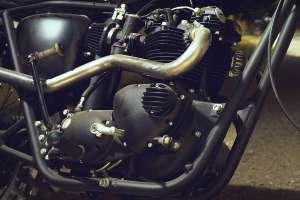
1984SC leaned heavily into that utilitarian ethos. At the heart of the chassis sits the iconic 650 cc vertical twin. The workshop tore the engine down to the bare cases and executed a comprehensive rebuild with new valves, fresh pistons and modern gaskets to ensure the notoriously leaky powerplant actually stays dry. It breathes through Amal carburetors with conical air filters, while spent gases exit via a custom high-mount exhaust. The raw steel pipes wrap tightly around the engine cases to avoid rock strikes and will naturally patinate to a bronze hue over time. True to the era, there are no mufflers or baffles of any kind.
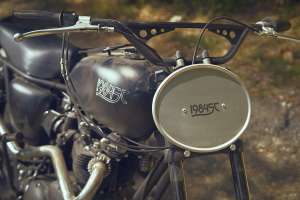
The front forks received a modern Diamond-Like Carbon coating to drastically reduce stiction under hard braking. A minor performance upgrade, DLC coating is also the only reliable way to achieve a blacked-out finish on surfaces that see constant wear. Out back, a tried-and-true twin-shock setup delivers period-correct ride quality.
While some would make a case for discs, 1984SC kept things old-school, maintaining the T120’s OE drums. The conical TLS drum up front is downright righteous, with its massive inlet vent for cooling. The heavy-duty wheels are fogged black from hoop to hub and wear mismatched rubber: a Pirelli M16 knobby in the rear and a bias-ply Ensign Trials Universal up front.
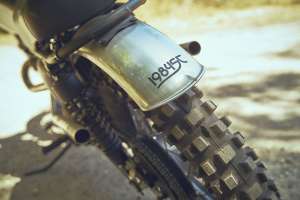
Getting the bodywork was a simple matter of restraint. The fuel tank is original, stripped of its flashy badging and adorned with a rack for holding maps and other quick-access items. The stock seat is long-gone, and in its place sits a tall, ill-fitting replacement. It looks like the type of item someone pillaged from a different bike 50 years ago because it worked better, and that’s exactly the point. Up front, a simple aluminum number plate with a bead-rolled edge fronts wide motocross handlebars and exposed control cables.
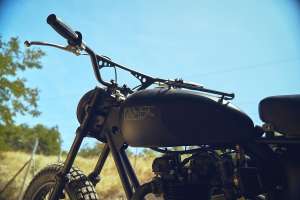
Aside from the pipes, aluminum panels and fasteners, the entire motorcycle is finished in a single shade of matte black. The big items were painted, but the rest was powder-coated in-house at the 1984SC facility. “The one-colour approach recalls the American desert racers of the 1960s and ’70s,” Jonathan says, “where function mattered more than show.” Devoid of lights, gauges or switches of any kind, the riding experience is defined by the throttle, clutch, two brakes and the rider.
Some might look at this Triumph desert sled and see nothing more than an old relic that’s been fogged black, and if so, 1984SC has mostly achieved their goal. But it takes a trained eye to see the decisions that were made to reflect historical accuracy. They could have cut the passenger peg mounts off, and they could have swapped the fuel tank, but you have to ask yourself: is that the way things would have been done in the 1970s?
In the world of eBay and Amazon Prime, it’s more difficult and costly to hold firmly to a bygone era, but the effect isn’t the same with a cart full of cheap parts. And when the build is just for kicks, even more credit is due.